Balance Augmentation Project
Undergraduate Research Assistant, Physiology of Wearable Robotics (PoWeR) Lab, Georgia Tech, May 2025 to present
What
A hip exoskeleton that helps users keep their balance during dynamic walking and perturbations. I process the EMG from perturbation trials on the CAREN platform and turn it into timing for the exoskeleton's assist.
Why
To help at the right moment, the exoskeleton has to know when, and how hard, the leg muscles respond after a perturbation.
How
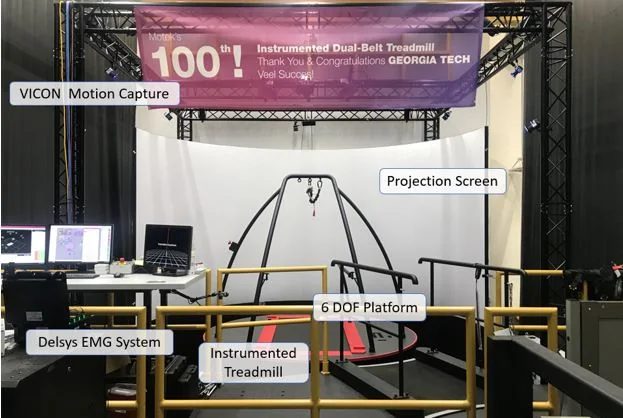
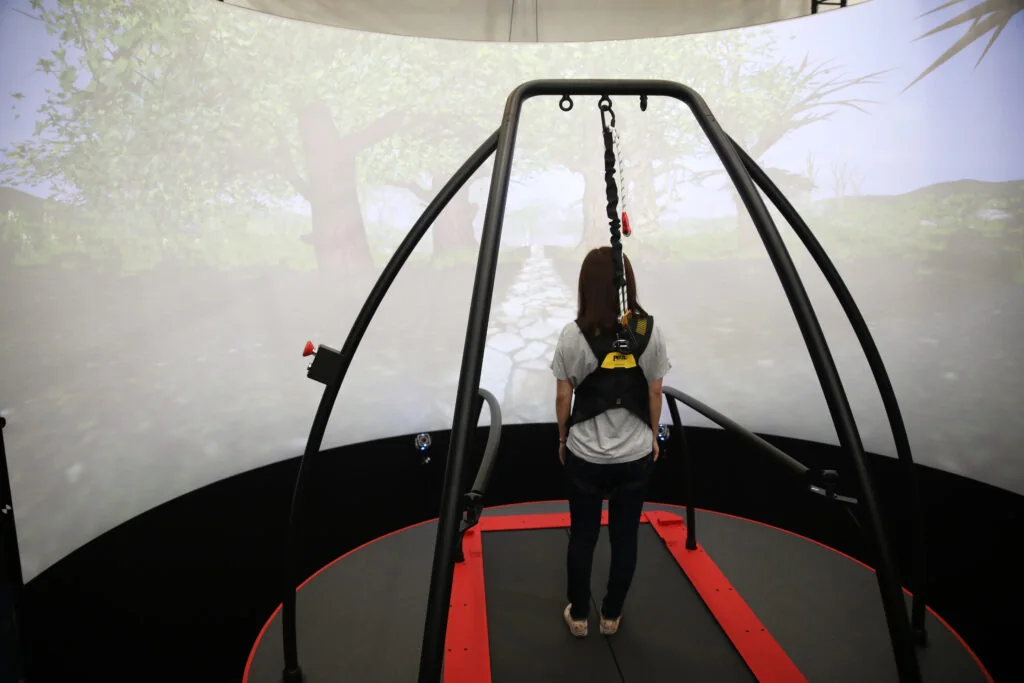
- Recorded lower-limb EMG while subjects walked on the CAREN, a VR rehabilitation system whose 6-DOF treadmill rotates and translates to simulate perturbations and terrain
- Built a MATLAB pipeline with a 20 to 450 Hz 4th-order Butterworth bandpass, full-wave rectification and a 50 to 100 ms moving RMS envelope
- Normalized amplitude to each participant's maximum voluntary contraction or trial maximum, and detected reflex onsets with a threshold
- Extracted latency, peak activation and recovery duration for rectus femoris, biceps femoris, tibialis anterior and medial gastrocnemius, and worked with the controls team to turn them into timing for the exoskeleton's assistive torque
- MATLAB
- EMG
- Signal processing
- Butterworth filtering
- CAREN
- Biomechanics
- Exoskeleton control
- Latency
- -
- Peak
- -
- Recovery
- -
The processing is real; the signal is illustrative, not study data.
Results
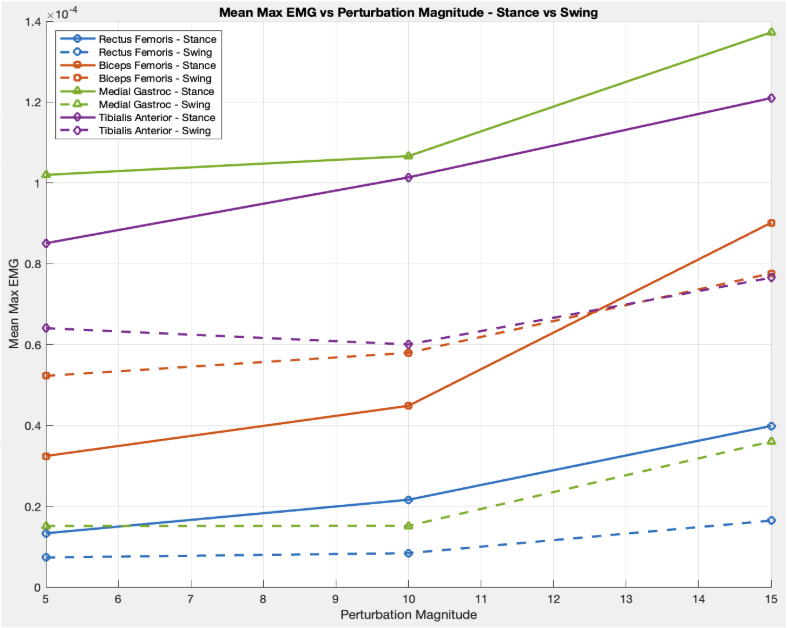
- Hip muscles in swing scaled sharply with perturbation size: rectus femoris +119% and biceps femoris +49% at 15 cm vs 5 cm
- Ankle muscles in stance rose more steadily: tibialis anterior +42% and medial gastrocnemius +12% at 15 cm
- Findings enable real-time control algorithms for the exoskeleton
- EMG acquisition protocols behind 50+ human-subject studies
What the muscles did
Mean max EMG rose with perturbation size. Hip muscles in swing jumped at 15 cm, pointing to their role in stepping; ankle muscles in stance rose more steadily, holding support during ground contact.
The CAREN
A treadmill on a 6-DOF motion platform inside a VR dome, with motion capture and wireless EMG. It shifts and tilts mid-stride to perturb balance.